How to get an A* in A-Level Economics: Complete Guide
Getting an A* isn't about being naturally good at Economics. It comes down to three habits: how you learn the content, how you write your essays and how you revise.
Our free 18-page guide shows you how to build each one, with worked examples, a full essay breakdown and a weekly plan you can stick above your desk.

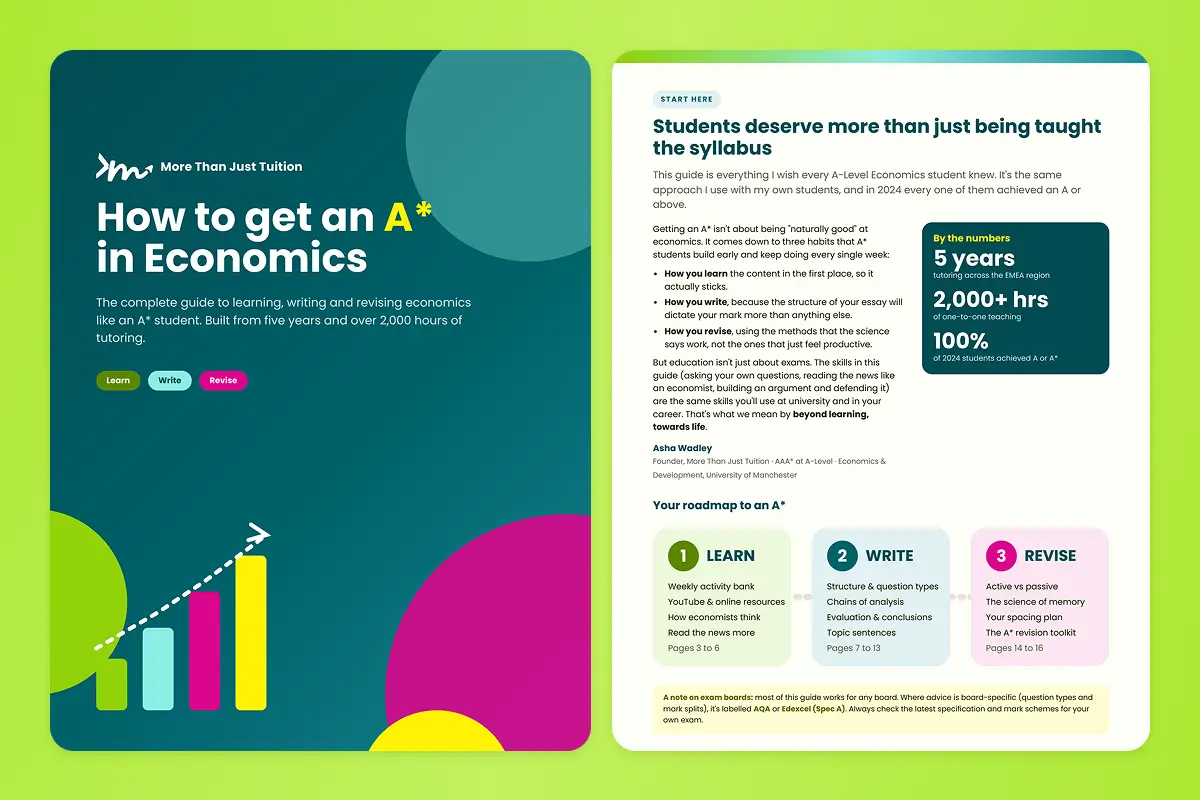
What's Inside The Free Guide
Eighteen pages, built from over 2,000 hours of one-to-one A-Level Economics tutoring. Most of it works for any exam board. Where the advice is board-specific, such as question types and mark splits, it's labelled AQA or Edexcel.
You'll also get Your A* week: a printable tracker with ten weekly habits across learning, writing and revising, so you can tick off your progress over four weeks.
1. Learn
- A weekly activity bank
- How economists think
- The best YouTube channels and online resources
- How to read the news like an economist
2. Write
- Essay structure and the four common structure problems
- Question types and mark splits for AQA and Edexcel
- Chains of analysis, step by step
- Evaluation, conclusions and topic sentences
3. Revise
- Active vs passive revision
- What the science of memory says
- Your spacing plan
- The A* revision toolkit
Getting an A* is About Habits, Not Talent
A lot of students believe an A* in A-Level Economics is only for people who are naturally good at the subject. In our experience, it isn't. It comes down to habits that A* students build early and keep doing every single week.
They learn the content in a way that actually sticks. They write with a clear structure, because the structure of your essay will dictate your mark more than anything else. And they revise using the methods the science says work, not the ones that just feel productive.
These habits don't stop at the exam. Asking your own questions and building an argument you can defend are the same skills you'll use at university and in your career. That's what we mean by Beyond Learning, Towards Life.
If you'd like to see how we teach this one-to-one, you can read more about our A-Level Economics tutoring.

How to Learn A-Level Economics Like an A* Student
A* students don't just sit through lessons. Every week, they do something with what they've learnt. Here are five activities from the guide's weekly bank. Choose one or two for each topic you cover.
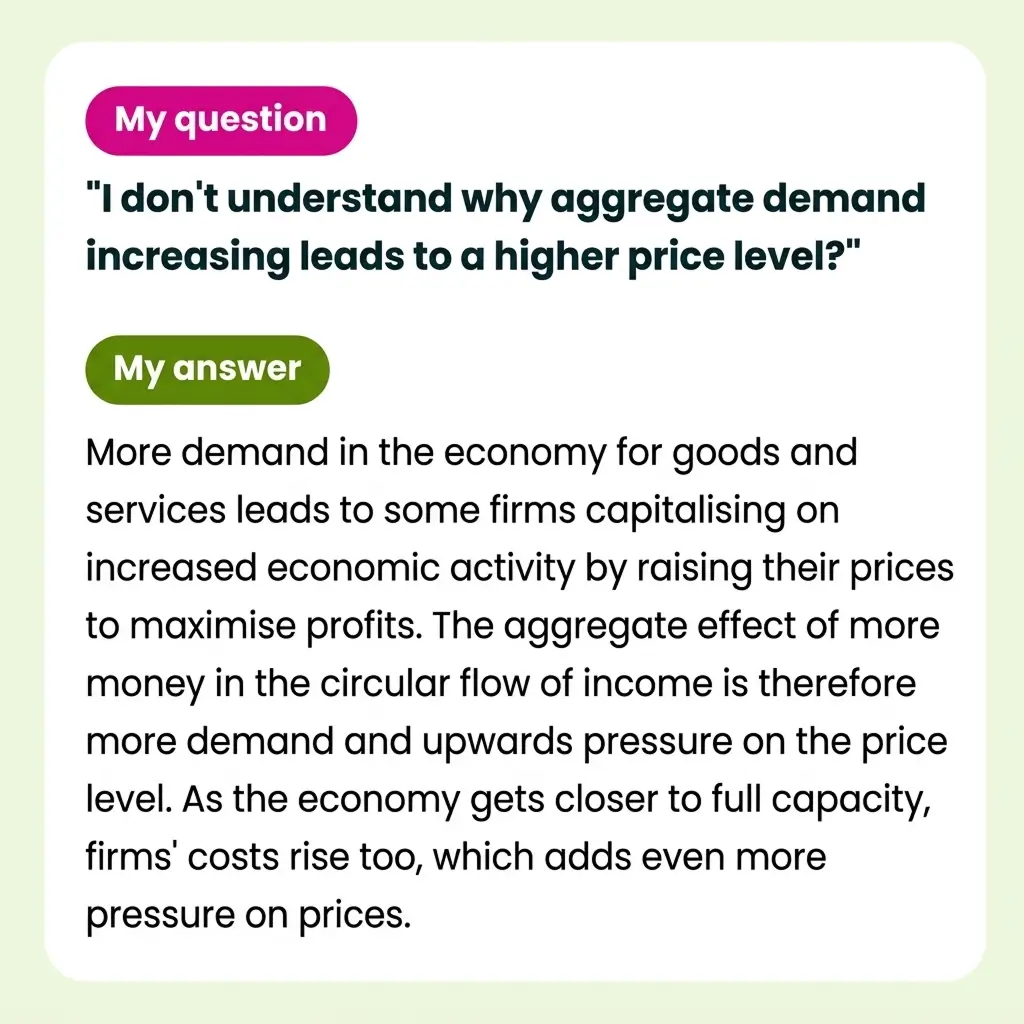
Answer Your Own Questions
Each week, write down everything you don't understand about the content you've learned. Then use research, YouTube videos and online resources to answer every one of your own questions.
The guide walks through two examples, including why rising aggregate demand leads to a higher price level.
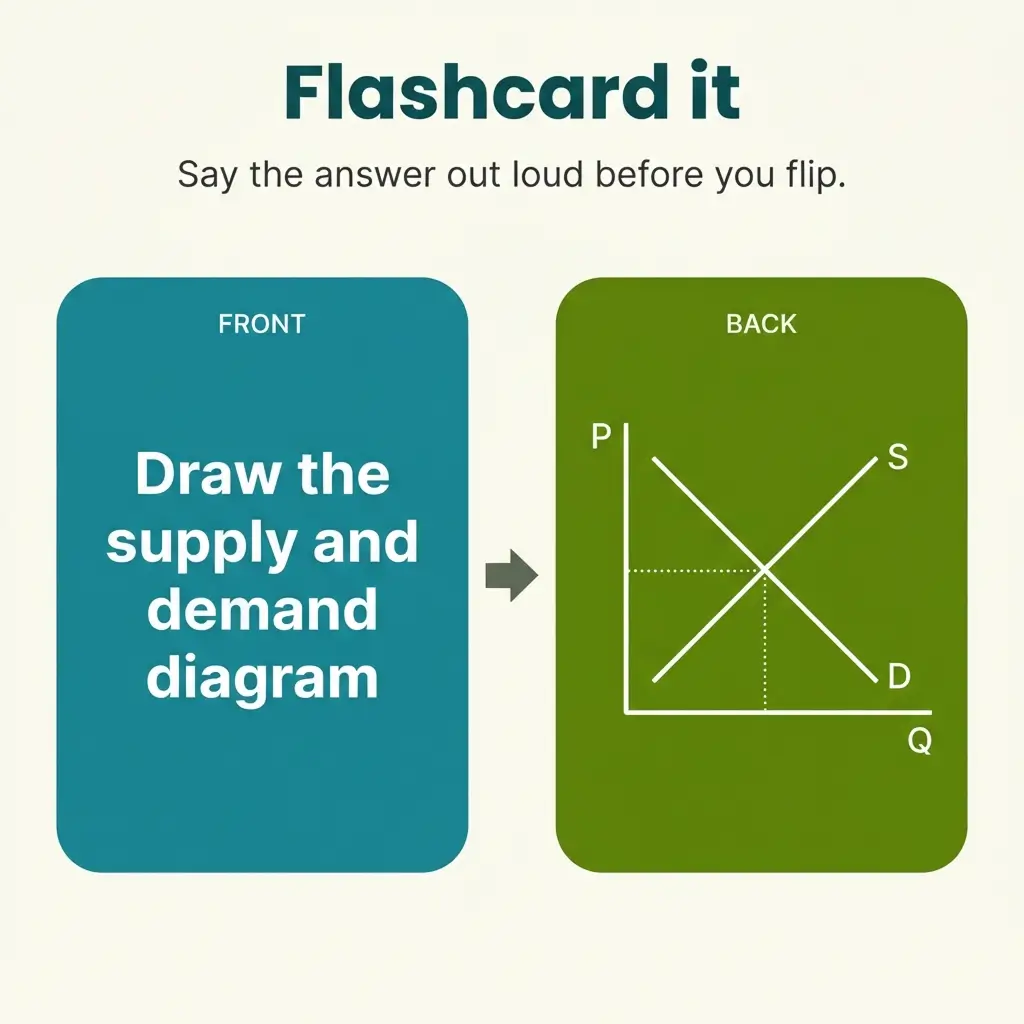
Flashcard It
Flashcard the topic and construct the diagrams that go with it. Draw every diagram from memory, labels and all, and say the answer out loud before you flip the card.
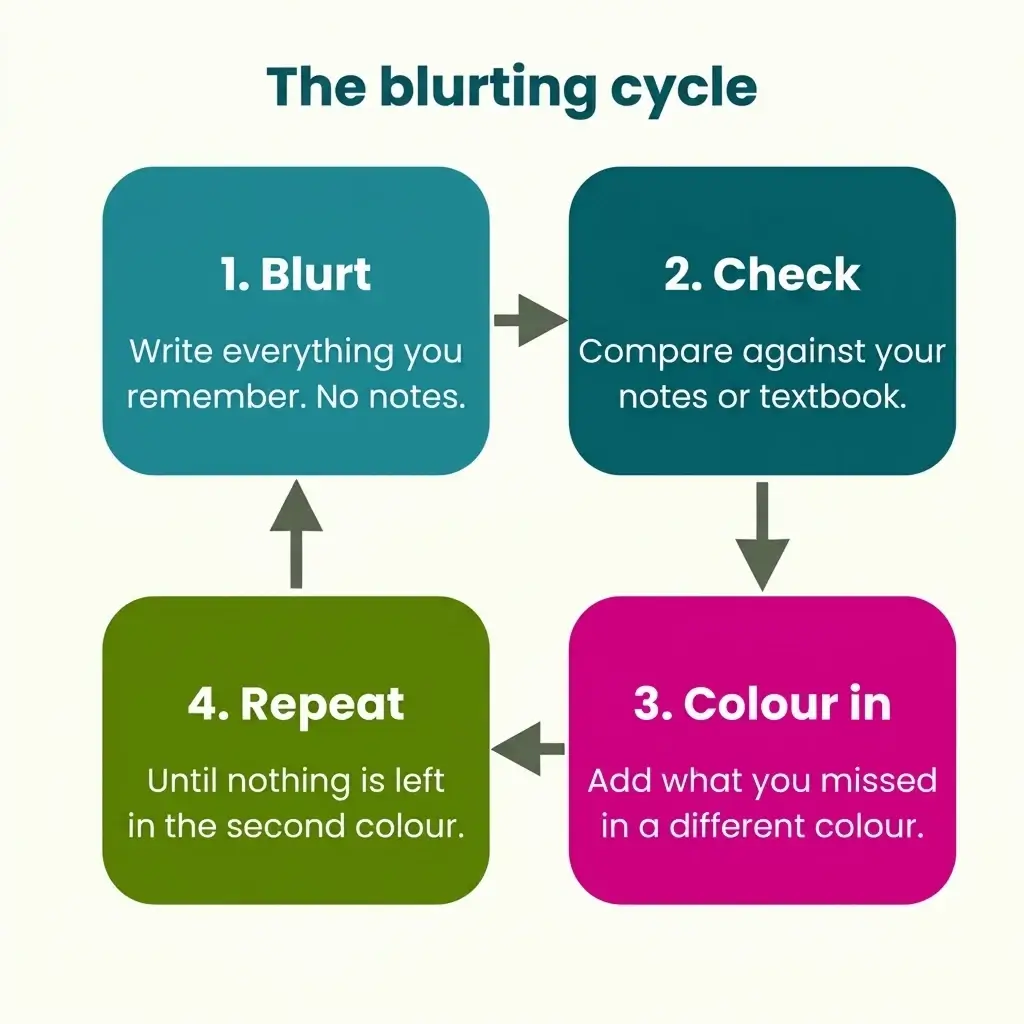
Blurt It
Write down everything you can remember about a topic, with no notes. Check it against your notes or textbook and add what you missed in a different colour. Repeat until nothing is left in the second colour.
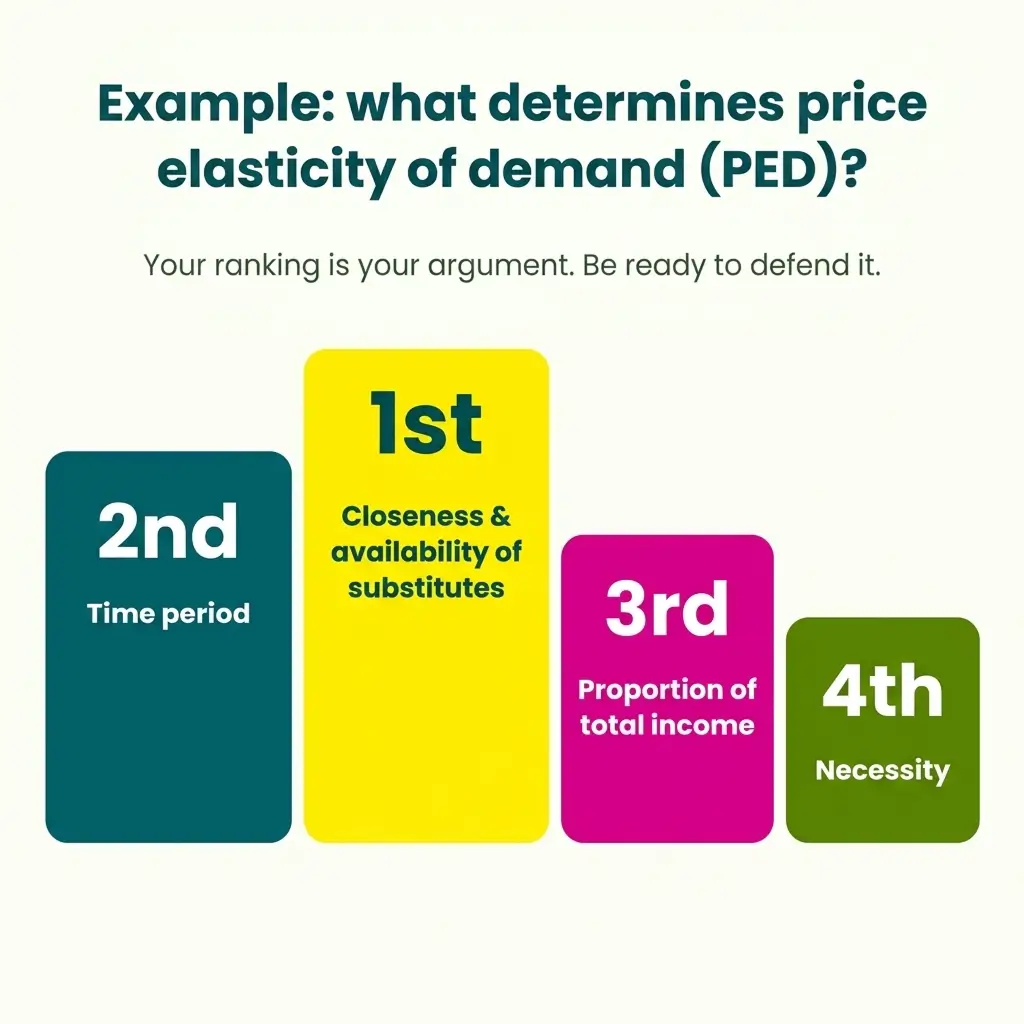
Rank It, Then Justify It
Rank the factors that influence the topic you've learnt, then justify your ranking.
Then question your own judgement with a "However…". That one sentence is the start of evaluation, and you're building it long before you sit an essay.
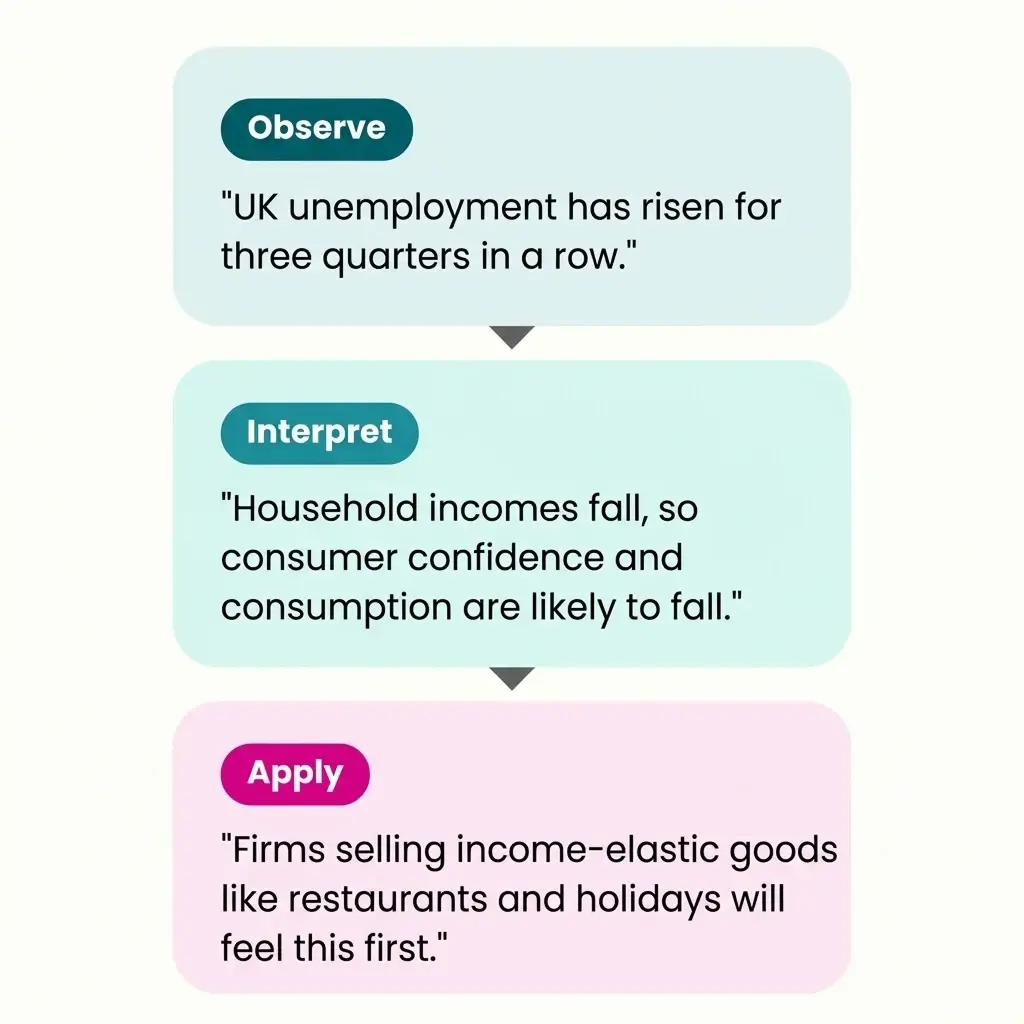
Play With Real Data
Look at an economic indicator that interests you on Trading Economics and write down what you notice.
Then interpret it: how could this change affect a market or a group of people? Keep two or three up-to-date statistics per topic. Specific application is what separates an A from an A*.
Learn to Think Like an Economist: Five Lenses For Every Essay
The syllabus gives you the content. A* students go one step further and learn the way of thinking behind it. Once you can see these five lenses, you'll spot them in every question, every news story and every essay.
Here Are The Five Lenses
- Everything has an opportunity cost. Resources are scarce, so every choice means giving something up.
- People respond to incentives. Change the price, the tax or the interest rate, and behaviour changes. Always ask: what incentive has changed, and for whom?
- Decisions are made at the margin. Firms and consumers ask whether one more unit is worth it.
- Everything is connected. One change ripples through the circular flow of income. Following that ripple is exactly what a chain of analysis is.
- Models simplify, and that's the point. Knowing what a model assumes is where your best evaluation points come from.
Asha teaches this way because of her own A-Level Economics teacher, who "used to explain the most abstract, theoretical concepts in the most simple way possible that related to something in front of you like a chocolate bar."
Read the news more than you usually would. Pick an article from the BBC News Economy page and note every economic process and term from your specification that you spot. Examiners reward application, and nothing applies better than something that happened this month.
For a step-by-step method, read our guide on how to apply economic theory to the real world.
Want to See Every Worked Example in Full?
The free guide has the worked answers behind each activity on this page, a full A* essay built step by step, a news-to-notes template you can reuse every week, and the YouTube channels and resources we recommend most.
How to Write A* A-Level Economics Essays
The guide breaks essay writing into seven building blocks, from structure and topic sentences to evaluation and the conclusion. Here's where to start.
Plan Your Structure Before You Write
Your structure decides how well your essay answers the question more than anything else. Spend two minutes planning: decide your side, list your points and give each point its own paragraph.
The guide also sets out what each mark tariff needs for AQA and Edexcel, from 2-markers to 25-markers.
Build Chains of Analysis With The "So What?" Test
A chain of analysis links each step to the next: what happens, which incentive has changed, who reacts and how, and how that leads back to the question. As Asha tells every student, "The examiner can't read our minds."
Asked what will happen if the Monetary Policy Committee lowers the base rate, one student wrote:
"If the interest rate decreases, then people will want to save more money and firms might also hire more people so the economy will grow."
It skips every step in between, and a lower base rate actually reduces the reward for saving. Try this instead: read each sentence of your paragraph and ask "so what?" If the next sentence doesn't answer it, you've found a missed entry point, and that's where the extra marks are.
The guide shows the A* version of this answer in full, mapped link by link.
Apply It to The Real World, and Connect Your Topics
Examiners reward specific application: recent data, the industry or group of consumers affected, and a clear link back to the question.
For ready-made examples, see our A-Level Microeconomics application and context examples and our A-Level Macroeconomics real-world examples.
Evaluate With Three Simple Options
Invert (why might it not happen at all?), think temporally (how does it change in the short run and the long run?) and think spatially (how does it differ at a local, national or international level?).
Inverting on its own can be weaker, so try to reach for the other two. The guide's evaluation bank has eleven more angles.
Open Every Paragraph With a Strong Topic Sentence
Each paragraph should open by paraphrasing the question to introduce your point, so someone could guess your essay question just from reading your essay. Then narrow down: your chain of analysis, your evidence and a sharp conclusion for that paragraph.
How to Revise A-Level Economics Like an A* Student
Active revision means pulling knowledge out of your own head, through flashcards, blurting, essay plans and practice essays. Passive revision, like re-reading and highlighting, feels productive but fades quickly. Here's what the research says, and how to make your revision active every week.
Swap Passive Revision For Active Revision
It's the study habit Asha would most like students to change:
"Just watching economic tutorial videos, they are good, but the majority of your revision should be active, like essay practice or flashcards, not passively reviewing notes or reading."
Feels productive (passive): re-reading notes and textbooks, highlighting and underlining, copying notes out neatly, and watching videos without doing anything after.
Actually works (active): flashcards for all of the content, blurting and mind maps, essay plans, and timed practice essays.
Why Re-Reading Tricks You
In one well-known study, students who read a passage once and then practised recalling it remembered 61% of it a week later. Students who re-read it four times remembered just 40% (Roediger and Karpicke, 2006). Re-reading feels like knowing, but in the exam nobody shows you your notes.
Space It Out
Come back to each topic just as you're starting to forget it, and the memory lasts longer each time. The guide turns this into a simple spacing plan, whether your mock is next week or your exams are a year away.

Hi, I'm Asha Wadley, Founder & CEO of More Than Just Tuition
I started More Than Just Tuition because students deserve more than just being taught the syllabus. After five years and over 2000 hours of teaching across the EMEA region, with every 2024 student achieving A grades or above, I realised my approach needed to reach more students.
Having achieved AAA* at A-Level (including Economics) and currently studying for a First Class degree in Economics and Development at the University of Manchester, I understand what it takes to excel academically.
But I also know education isn't just about exams & academics, it's about preparing for adulthood. By 22, I'd worked at a global bank, a cryptocurrency startup, an NGO in Uganda, and the University of Manchester itself. Now, I use that experience to help students progress beyond learning towards life.
Success Stories From Our Students
See how our personalised online tuition and career coaching have helped students excel academically and professionally.
Success Story of
Heading 1
Heading 2
Heading 3
Heading 4
Heading 5
Heading 6
Lorem ipsum dolor sit amet, consectetur adipiscing elit, sed do eiusmod tempor incididunt ut labore et dolore magna aliqua. Ut enim ad minim veniam, quis nostrud exercitation ullamco laboris nisi ut aliquip ex ea commodo consequat. Duis aute irure dolor in reprehenderit in voluptate velit esse cillum dolore eu fugiat nulla pariatur.
Block quote
Ordered list
- Item 1
- Item 2
- Item 3
Unordered list
- Item A
- Item B
- Item C
Bold text
Emphasis
Superscript
Subscript
Read Success Story
Success Story of Anaya A-Level Economics Student
Anaya began her A-Levels feeling overwhelmed by the breadth of the Economics specification. She understood topics individually, but couldn't connect them, making essays feel fragmented and limiting her to B/C grades. Across two years of tailored support, she first built strong conceptual foundations in Year 12, then refined her exam technique and essay writing in Year 13.
The result: an A* in A-Level Economics, a two-grade improvement built on sustained, personalised tutoring that addressed both understanding and application.
Read Anaya's Success Story
Success Story of Ben A-Level Economics Student
Ben started his A-Levels averaging C and D grades in Economics. He knew the content, but struggled to translate it into high-scoring exam answers, particularly when it came to essay structure and building clear chains of analysis. Through weekly sessions focused on exam technique, structured essay planning, and analysing model answers, Ben developed both deeper subject understanding and a disciplined approach to writing.
By the end of his AS Levels, he was achieving A* grades on essays, a four-grade improvement that transformed both his results and his confidence.
Read Ben's Success Story
Heading 1
Heading 2
Heading 3
Heading 4
Heading 5
Heading 6
Lorem ipsum dolor sit amet, consectetur adipiscing elit, sed do eiusmod tempor incididunt ut labore et dolore magna aliqua. Ut enim ad minim veniam, quis nostrud exercitation ullamco laboris nisi ut aliquip ex ea commodo consequat. Duis aute irure dolor in reprehenderit in voluptate velit esse cillum dolore eu fugiat nulla pariatur.
Block quote
Ordered list
- Item 1
- Item 2
- Item 3
Unordered list
- Item A
- Item B
- Item C
Bold text
Emphasis
Superscript
Subscript
Read Their Success Story
Asha has been an incredibly helpful and supportive tutor for my son as he worked through his GCSE Economics studies. Her ability to clearly explain key concepts and make complex ideas more understandable had a real impact on his confidence and progress. Each session was insightful and well-paced, and my son always felt comfortable asking questions and engaging with the material thanks to Asha’s calm and patient approach.
What also stood out was Asha’s flexibility and understanding when we needed to reschedule sessions due to other commitments. She was always accommodating and worked with us to find suitable alternatives, which made a big difference during a busy and sometimes stressful period.
Overall, Asha’s knowledge, patience, and adaptability made her an excellent tutor, and I wouldn’t hesitate to recommend her to anyone looking for Economics support at GCSE level. I look forward to results day!!! Thank you Asha :-)
Read Amari Success Story
Asha is really intelligent and well prepared. She knows her way around the subject and is able to explain and help her students absorb the material properly.
Read Steve Success Story
Asha is quite knowledgable, engaging, supportive, kind and persuasive. My daughter enjoyed her first lessons and she is looking forward to her upcoming lessons. We would highly recommend her. Many thanks Asha and all the best!:)
Asha was an amazing tutor, had her for just a short period of time for my end of year AS exams. She explained concepts very well and helped me achieve my desired grades.
Asha explains elements of economics in precise detail. She is very patient with her students which I appreciated. Would 100% recommend.
Asha is great with my son. My son had his first trial lesson and found it very interactive and lesson is engaging.
Asha is responsive, patient and helpful. Highly recommend her for anyone who needs tutoring in economic theories.
She was really understanding and not judgemental if u didn’t remember things or if I got questions wrong and I felt really comfortable and confident with her as she helped me to understand things in a different way.
In my opinion, Asha is great! As a year 13 student who's struggling with economics, she was really helpful by breaking down and explaining the steps for writing strong paragraphs and essay answers in long answer questions, as well as being very encouraging and reassuring whilst teaching! One of the nicest tutors I've had and I'd strongly recommend her for as a tutor.
Fantastic guidance at A level, Very knowledgable and a great Teacher. Very accommodating with little notice. Helped to improve confidence for my son.
Get Your Free Guide to an A* in A-Level Economics
This page is the starting point. The full guide gives you the worked examples, model answers and templates that turn these habits into marks. Inside its 18 pages, you'll get:
Worked answers for the weekly learning activities, from aggregate demand to price elasticity
A 25-mark essay built step by step, with an A* chain of analysis mapped link by link
Question types and mark splits for AQA and Edexcel, from 2-markers to 25-markers
An evaluation bank with eleven angles you can use on almost any question
A spacing plan for your revision, whether your mock is next week or your exams are a year away
Your A* week: a printable tracker to stick above your desk
It's built from over 2,000 hours of one-to-one A-Level Economics tutoring, and it's the same approach behind our 2024 results, when all of our students earned an A or A*. Start with one habit this week. You've got this.