How to Understand Economics: Stop Memorising
Four hours the night before a mock. Notes read cover to cover, twice. A genuine feeling of readiness walking into the exam hall.
Then an essay question that used a concept in a way that felt completely unfamiliar. The theory wasn’t new, but it wasn't presented the way it had been in the notes. A blank page where a confident answer should have been.
The question isn’t whether the student didn't work hard. The reason is they worked hard at the wrong thing.
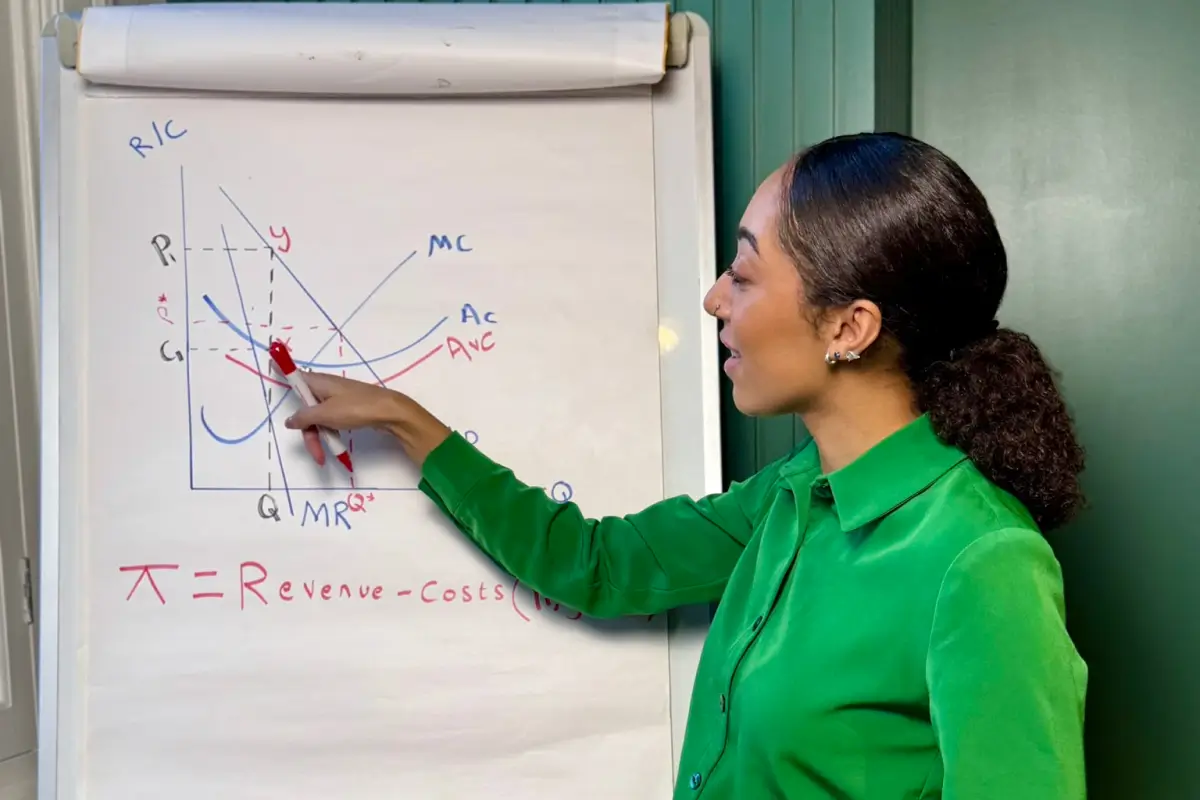
Hi, I'm Asha Wadley, Economics tutor, founder of More Than Just Tuition, and someone who genuinely believes education should prepare you for life, not just exams. With five years of teaching experience, every 2024 student I worked with achieved an A or above.
In that time, the single biggest gap I've seen between students who improve quickly and students who plateau despite genuine effort isn't intelligence or work ethic. It's the difference between studying that feels productive and studying that actually builds transferable understanding.
This blog explains that difference and gives you a specific, practical method to close it.
Why Memorisation Fails in Economics Specifically
Here's the thing most students don't realise until it costs them marks: the exam was never going to ask you to recall a definition. It was always going to ask you to apply theory to a real-world context you've probably never seen presented that way before.
Memorised facts are brittle. They work perfectly when a question matches exactly what you revised and fall apart the moment it doesn't.
If you've memorised "a subsidy is a payment made by the government to reduce the cost of production," you can recite that sentence flawlessly.
But if the exam asks you to evaluate whether a subsidy on electric vehicles is an effective way to correct a positive externality, that memorised sentence gives you almost nothing to work with.
Genuine understanding is flexible. It transfers to unfamiliar contexts because you understand the underlying mechanism, not just the label attached to it.
That flexibility is precisely what economics exams are designed to test, and it's exactly what memorisation alone can't produce.
If you're reading this because you've noticed this gap already, content revised, marks not reflecting it, then it's worth reading alongside our guide on falling behind in A Level Economics, which covers what to do when the gap has become a genuine problem rather than just an inefficiency.
What Does Understanding Economics Actually Mean?
"I feel like I know this" is not a useful test. Here's a better one, three concrete questions to ask yourself about any topic:
- Can you explain the concept in plain English, without economics jargon?
- Can you predict what happens if one variable in the model changes? What happens to the price of oil if OPEC cuts output? What happens to consumer surplus if a good becomes more price inelastic?)
- And can you apply the concept to a real-world example you've never used before, not just the one from your notes?
If you can't do at least two of these three for a given topic, you don't yet understand it, regardless of how many times you've read the notes on it.
This isn't a discouraging standard. It's an honest one, and it's the standard the exam actually holds you to.
Active Recall (The Foundational Technique)
Re-reading notes feels productive. It creates a genuine sense of familiarity, you see a concept, you recognise it, and that recognition feels like knowledge. It isn't.
Recognition and recall are not the same thing.
Recognition is seeing something and thinking "yes, I remember this." Recall is being able to produce that same information from memory, with nothing in front of you. The exam only ever tests recall. Most students only ever practise recognition.
Here's how to actually do active recall for economics: close the notes completely. Write out everything you know about a topic from memory (the definition, the diagram, the real-world example, the evaluation points).
Then, and only then, check it against your original notes. Note specifically what you missed, not just that you missed something.
The gaps revealed by this process are more valuable than anything re-reading ever gives you, because they show you exactly where your understanding is thin, while there's still time to fix it, rather than discovering it in an exam hall.
The Feynman Technique (Adapted for Economics)
Named after physicist Richard Feynman, this method is simple to describe and genuinely uncomfortable to do properly: explain a concept as if teaching it to someone with no economics background at all, using plain language, no jargon.
Here's where it becomes powerful. The exact point where your explanation breaks down, or where you have to reach for a technical term to keep going, is the exact point where your understanding is incomplete.
Try it with market failure. Explaining it as "when the free market doesn't produce the best outcome for society" is a definition, not an explanation.
A genuine explanation sounds more like: "sometimes when people buy and sell things, other people who weren't part of that transaction end up affected by it too and because the price never accounted for that effect, the market ends up producing either too much or too little of that good."
If you can get there fluently, you understand the mechanism. If you can't get past the definition, you've memorised a term without understanding what it describes.
Build Understanding Through Application and Not From Definitions Only
Knowing what "price elasticity of demand" means is a completely different skill from applying it to a real-world example or a past paper question and the exam only rewards the second one.
Here's the practical method: for every concept you study, find or create one genuine real-world example, and explain specifically why the theory applies to it.
Not just naming an event, but explaining the mechanism. The same standard covered in our real world examples guide for microeconomics. This is precisely the application skill that separates a grade B from a grade A.
And past paper practice should come earlier in your revision than most students think. Not as a final test to confirm what you already know, but as an active tool throughout your revision for building the specific skill of applying theory to a context you haven't seen before, because that's the actual skill the exam is testing, and it can only be built by practising it directly.
Understand Diagrams Properly, Don’t Just Memorise Their Shape
A very specific, very common failure pattern: a student who can draw a perfect supply and demand diagram from memory, in seconds, with every label in the right place, but can't explain why a shift happens, or predict what happens to the equilibrium price if a different variable changes.
That's memorisation of a shape, not understanding of a model.
Studying a diagram properly means understanding what each axis actually represents and why. It means understanding the causal mechanism behind why each curve is shaped and positioned the way it is, not just that it looks that way.
And it means practising drawing the diagram from a written scenario, rather than copying it from memory, because the exam gives you a scenario, not a blank diagram to reproduce.
This applies directly across the syllabus: AD/AS diagrams, PPF curves, market failure diagrams. The same underlying principle holds for every visual model you'll encounter, the shape is not the understanding. The shape is just what the understanding looks like once you've built it.
Spaced Repetition - Why Cramming Creates False Confidence
Cramming produces a very specific, very misleading feeling: readiness. And that feeling doesn't reflect actual long-term retention.
Information crammed the night before an exam is often gone within days, sometimes within hours.
This is exactly why it collapses under exam pressure: an exam that requires applying knowledge flexibly needs that knowledge to be genuinely embedded, not freshly loaded and still fragile.
Spaced repetition: reviewing material at increasing intervals over time, rather than all at once, builds durable, retrievable understanding instead of short-term familiarity.
Practically, this means revisiting a topic after one day, then again after one week, then again after a month.
That pattern is measurably more effective than four consecutive hours of review the night before a test, even though four hours the night before feels like more effort in the moment.
The Honest Trade-Off
None of this is more comfortable than re-reading notes. If anything, it's less comfortable, especially at first. Active recall in particular can feel genuinely discouraging, because it exposes what you don't know rather than reinforcing what you already do.
Here's the honest reframe: that discomfort is the method working, not a sign it's failing.
The entire value of active recall is in surfacing gaps early, while there's still time to close them, rather than discovering them for the first time in an exam.
And here's the part that makes the extra effort worth it: this approach takes more time upfront, but considerably less time overall. Understanding transfers to new questions.
Memorisation has to be rebuilt, topic by topic, before every single assessment, because it was never actually retained in a usable form to begin with.
The Bottom Line
The students who improve fastest in economics aren't the ones who revise the most hours. They're the ones who revise using methods that build transferable understanding rather than surface familiarity.
Studying that feels hard and studying that works are usually the same thing.
Active recall, application practice, and diagram-based understanding are exactly the kind of methodology a good tutor can help you build systematically, with real feedback on exactly where your understanding is genuinely thin, rather than guessing.
If you want structured support putting these techniques into practice, book a free 20-minute Economics trial lesson with More Than Just Tuition.
Key Takeaways:
- Memorised facts are brittle and fall apart on unfamiliar exam questions, while genuine understanding transfers because it's built on mechanism, not just labels
- Test real understanding with three questions: can you explain it in plain English, predict what happens if a variable changes, and apply it to a new example
- Active recall (writing from memory, then checking gaps) builds far more retention than re-reading notes ever will
- The Feynman technique reveals exactly where understanding breaks down: explain a concept simply, and notice where jargon becomes necessary
- Practise application and past papers throughout your revision (not just at the end), it's the specific skill the exam actually tests
- Study diagrams by understanding causation (not by memorising their shape), practise drawing them from a written scenario
- Spaced repetition beats cramming because it builds durable retention rather than a fragile, short-lived feeling of readiness
Want help building these techniques systematically, with real feedback on where your understanding needs work?
Book a free 20-minute Economics trial lesson with More Than Just Tuition. No commitment, just a real conversation about where you are and what would help.
Learn, Grow, and Succeed With the More Than Just Tuition Blog
Practical advice on economics, exams, university applications, career planning, and student wellbeing. Our blog is written for students who want more than just grades, they want clarity, confidence, and purpose in life.