How to Prepare for an Economics University Interview
You've revised harder than you ever have. You know your economics. You can write a 25-mark essay, you've done the past papers, you've read the mark schemes. And then you walk into a university interview and the first question isn't anything like what you prepared for.
Not a content question. Not something from the syllabus. Something open-ended, something genuinely difficult, and the interviewer is just watching you. Waiting to see what you do with it.
This is the moment most students discover they've been preparing for the wrong thing.
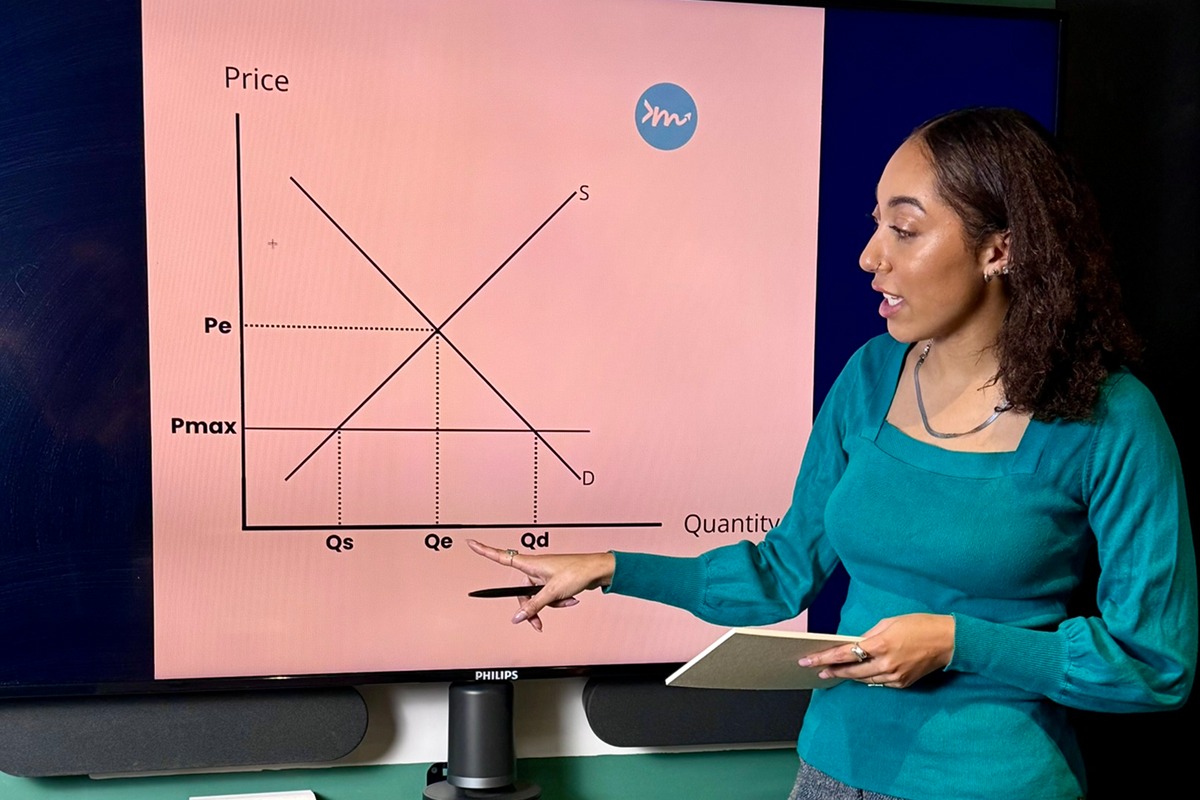
Hi, I'm Asha Wadley, Economics tutor, founder of More Than Just Tuition, and someone who genuinely believes education should prepare you for life, not just exams. With five years of teaching experience, every 2024 student I worked with achieved an A or above. Everything I write comes from that experience, and from knowing what it actually takes to get there.
What follows is what I'd tell a student the week before their economics university interview. Not more content to memorise. A different way of preparing entirely; one that matches what competitive university interviews are actually designed to test.
What Economics University Interviews Are Actually Testing
Let's start with the reframe, because without it the rest of this blog won't land.
Most students walk into an economics university interview thinking it's an extension of their A Level: demonstrate knowledge, answer questions correctly, impress the interviewer with what you know. That framing is wrong, and it's why well-prepared students still freeze.
University economics interviews, particularly at Oxford, Cambridge, and competitive Russell Group universities, are not testing what you know. They're testing how you think. Specifically, they're testing whether you can reason through a problem you've never encountered before, out loud, under pressure, in real time.
The interviewers sitting across from you are asking five questions simultaneously, none of which appear on the interview schedule:
- Can this student reason through a problem they haven't seen before, or do they only perform well on familiar ground?
- Do they think in mechanisms; cause, effect, condition, or do they reach for definitions when things get difficult?
- Can they hold two competing ideas at once, argue one side and then complicate it themselves?
- When I push back, do they think harder or shut down?
- And is their intellectual curiosity genuine, or is it a performance assembled for the application?
Oxbridge interviews in particular are designed to feel uncomfortable. That discomfort isn't accidental. That's the point. An interviewer who asks you a question you can't immediately answer isn't trying to trip you up, they're putting you at the edge of your understanding deliberately, to see what you do there.
The implication is important: a student who has memorised every economics topic but can't think flexibly under pressure will underperform relative to a student with slightly less content knowledge and genuine analytical confidence. The preparation most students do is the preparation that matters least on the day.
What Interviewers Are Specifically Looking For
"Be curious" is the advice every economics applicant gets. It's also completely useless without knowing what curiosity actually looks like in an interview room. Here's the concrete version.
Reasoning out loud:
The ability to say "I think this happens because..." and then develop the thought in real time, instead of reciting a pre-prepared answer. Interviewers can distinguish immediately between a student who is thinking and a student who is performing. Thinking sounds tentative and exploratory. Performing sounds polished and hollow.
Intellectual honesty:
"I'm not sure, but if I reason through it..." is more impressive than a confident wrong answer. Interviewers are not rewarding correctness, instead they're rewarding the quality of the reasoning process. A student who says "I don't know, but let me try to work it out from first principles" and then actually does, is demonstrating exactly the kind of mind a university wants to teach.
Economic intuition:
The ability to apply the tools of economic thinking; incentives, trade-offs, opportunity costs, market mechanisms to questions that may not immediately look like economics. If you're asked about why people queue for concert tickets rather than paying higher prices, the student who reaches for price theory and welfare economics is thinking like an economist. The student who says "because it's fairer" is not.
Engagement with challenge:
When an interviewer pushes back on your argument, the instinct should be to think harder, not retreat. This is perhaps the most important signal of all. An interviewer who disagrees with you is not telling you that you're wrong, they're watching how you respond to intellectual pressure. Updating your view in response to a good counter-argument is a strength. Defending a position you no longer believe in because you're afraid to change it is a weakness.
Genuine curiosity:
This is the hardest quality to fake and the easiest to develop authentically. It comes from actually reading about economics beyond the syllabus, from caring about the ideas, not just the grades. You can't manufacture this in the week before an interview. But you can cultivate it over a term, and it shows.
How to Approach a Question You've Never Seen Before
This is the section that matters most because every economics interview will contain at least one question you haven't prepared for. The framework below is what separates students who navigate those moments from students who freeze.
The biggest mistake students make is waiting to know the answer before they start speaking. In an economics interview, thinking out loud is the answer. The process of reasoning is what's being evaluated, not the conclusion you arrive at.
Step 1 - Anchor to a principle:
What economic concept is closest to this problem? Start there, even if it doesn't fit perfectly. "This feels like a question about price elasticity..." or "There seems to be an externality here..." gives you a foothold. It also signals to the interviewer that you think in economic frameworks rather than in general common sense.
Step 2 - Identify the mechanism:
What are the cause-and-effect relationships? Draw them out verbally. "If the government does X, then firms will respond by Y, because the incentive structure changes in Z way." The mechanism is the argument. Students who skip to conclusions without explaining the mechanism are leaving out the most valuable part.
Step 3 - Complicate the picture:
What would change this outcome? What are the conditions under which your argument doesn't hold? This is where evaluation lives and it's what separates a competent answer from an impressive one. "However, this assumes that demand is relatively elastic, which may not be the case if..." shows that you're genuinely thinking, not just presenting.
Step 4 - Reach a qualified position:
Don't sit on the fence interviewers find equivocation frustrating. But don't pretend certainty you don't have. "On balance, I think the policy would likely reduce consumption in the short term, because... but the long-term effect is less clear and would depend on..."
A worked example:
The interviewer asks: "Should the government cap supermarket food prices?"
A weak response: "Probably not, because it would distort the market and reduce supply. Price controls generally cause shortages."
That's not wrong. But it's thin. It's a definition masquerading as analysis.
A strong response:
"My instinct is no, but let me reason through it. A price ceiling set below the market equilibrium would reduce the incentive for supermarkets to supply those goods, because profit margins compress. You'd expect shortages over time, particularly for perishable products where supply is already tight.
However, there's a distributional argument worth taking seriously - if food prices are rising faster than wages for low-income households, the social cost of inaction might outweigh the efficiency cost of intervention.
The question is whether there are better instruments available, for instance targeted transfers or subsidies might achieve the distributional goal without the supply distortion. On balance, I'd argue against a price cap, but I'd want to understand the scale of the distributional problem first."
Same starting position. Completely different quality of thinking.
Using Current Economic Affairs Confidently
Current affairs matter in economics interviews, not as name-drops, but as evidence that you're engaging with the subject beyond the syllabus. The distinction is important.
"The Bank of England raised interest rates" is not impressive. It's a fact anyone could read from a headline. What's impressive is the mechanism behind it: why rates were raised, what the transmission mechanism looks like, what the time lag implies, and what the risks of that policy are on the other side. That level of fluency takes time to build and it can't be assembled the night before.
Going into interview season, there are four economic topics worth being genuinely fluent in instead of just memorising the facts:
Inflation and monetary policy - what causes inflation, how central banks respond, what the transmission mechanism involves, and the trade-offs between controlling inflation and supporting growth. This has been the dominant macroeconomic story for the past three years and will almost certainly come up.
Labour market dynamics - unemployment, wage growth, the relationship between tight labour markets and inflation, and structural changes to work post-pandemic.
Fiscal policy and government debt - how governments borrow, what the constraints are, the debate between austerity and stimulus, and how bond markets respond to fiscal decisions.
Energy markets and supply-side shocks - the economics of energy transition, how supply shocks transmit through an economy, and the policy trade-offs involved in responding to them.
The habit to build: read one serious economics story per week. Apply the framework; mechanism, effect, condition. Write three sentences on what you understand. That practice, sustained over a term, is what genuine fluency looks like rather than a rushed revision exercise.
For sources, The Economist and the Financial Times (free student access) are the standard. The Bank of England's explainer content is underused and genuinely excellent. CORE Economics bridges academic theory and real-world application better than most textbooks.
Why Good Students Still Freeze, The Most Common Mistakes
These are the patterns I see most often in students who are well-prepared by conventional measures and still underperform in interview conditions.
Over-preparing content, under-preparing thinking:
Spending 90% of preparation time on syllabus revision and 10% on reasoning practice is the inverse of what interviews reward. Content knowledge is the foundation, not the ceiling.
Giving a pre-prepared answer to a question that wasn't asked:
Interviewers can identify this immediately. Steering the conversation toward a topic you've rehearsed signals exactly what they don't want to see; an inability to engage with what's actually in front of you.
Retreating when challenged:
A follow-up question from an interviewer is not a signal that you got it wrong. It's an invitation to go further. Students who interpret challenge as failure shut down exactly when they should be opening up.
Performing confidence rather than demonstrating thinking:
Fluent, economically-worded answers that contain no actual reasoning are one of the most common patterns in interview preparation. The vocabulary is there. The thinking isn't. Interviewers find this more frustrating than a student who thinks slowly but genuinely.
Treating silence as failure:
Pausing to think is not a weakness. "Let me think through that for a moment" is what a genuine thinker sounds like. Filling silence with unprocessed thoughts to avoid the discomfort of a pause produces the weakest answers of any interview.
How to Prepare in the Weeks Before Your Interview
Practise reasoning out loud, not just thinking:
The skill being tested is verbalisation, which is the ability to construct and develop an argument in spoken form, in real time. Thinking through problems silently does not build this skill. Find someone such as a tutor, a teacher, a peer etc. who will ask you economics questions and respond to what you actually say rather than what you meant to say.
Read seriously, not broadly:
Three economic topics understood well are more valuable than ten understood superficially. Depth of engagement is what produces genuine fluency. Choose your topics and go deep.
Practise being wrong gracefully:
Set up conversations specifically designed to challenge your economic arguments. The goal is not to defend your position, instead it's to practise the experience of updating your thinking under pressure without shutting down. This is a skill and it needs repetition.
Know your personal statement inside out:
Interviewers will ask about what you've written. Every book you mentioned, every idea you referenced, every claim you made, you need to be ready to develop it further, not just restate it. "I read that" is not an answer. "I read that, and the argument that struck me most was..." is.
Mock interviews are not optional:
For competitive university applications, a mock interview with someone who understands how to push back on economic reasoning is the closest preparation to the real thing. Reading about interview technique is useful. Experiencing it is essential.
At More Than Just Tuition, this is exactly what our sessions are built around - not content delivery, but analytical reasoning practised out loud with real feedback. The students who prepare for interviews this way are not just better prepared for the interview. They're better economists.
Conclusion
The students who perform best in economics university interviews are rarely the ones who know the most. They're the ones who've learned to think out loud, engage with challenge, and reason through the unknown without shutting down.
The preparation that matters is not more content. It's practising the act of thinking out loud, under pressure, with someone who pushes back.
An economics interview isn't asking you what you know. It's asking you what you do when you don't know and that's a skill you can build.
Learn, Grow, and Succeed With the More Than Just Tuition Blog
Practical advice on economics, exams, university applications, career planning, and student wellbeing. Our blog is written for students who want more than just grades, they want clarity, confidence, and purpose in life.